
URL Slug: meta-glasses-hipaa-risks-kentucky-healthcare
Meta Description: Meta Ray-Ban glasses are a HIPAA nightmare for Lexington healthcare providers. Learn why AI glasses fail privacy rules and how to protect your clinic from $50k fines.
In the hallways of medical clinics from Lexington to Georgetown, a new kind of "shadow IT" is creeping in, and it looks exactly like a pair of classic Ray-Bans. We’re talking about Meta’s smart glasses: the sleek, AI-powered wearables that can record video, snap photos, and even livestream to social media with a single tap.
While they might be the coolest gadget of the year, for Central Kentucky healthcare providers, they are a high-stakes liability. At IT-Necessity, we see tech trends through a specific lens: security and compliance. When a patient, a vendor, or even a well-meaning staff member walks into your exam room wearing these, they aren't just wearing glasses; they are wearing a high-definition camera and microphone that "phones home" to Meta’s servers every chance it gets.
The reality is blunt: Meta Ray-Bans are not HIPAA-compliant. Using them around Protected Health Information (PHI) is a one-way ticket to a massive Office for Civil Rights (OCR) investigation and fines that can easily top $50,000 per violation. In this post, we’re breaking down why this "cool tech" is a massive risk for your Kentucky practice and what you need to do about it today.
The Invisible Camera: Why Smart Glasses Are Different
Unlike a smartphone: which is obvious when someone is holding it up to record: smart glasses are designed to be covert. A patient sitting in your waiting room in Frankfort could be recording the check-in process, capturing names on a sign-in sheet or the medical details being discussed at the front desk, all while looking like they’re just waiting for their appointment.
For healthcare providers in Central Kentucky, this creates a brand-new privacy gap. PHI isn't just what’s written in an EMR or EHR system; it’s any identifiable information. This includes:
- Faces of other patients in the hallway.
- Patient names or dates of birth visible on a computer monitor or a wristband.
- Audio recordings of clinical conversations in the exam room.
Technical Breakdown: Why Meta Glasses Fail the HIPAA Test
To understand why these glasses are a nightmare, we have to look under the hood. HIPAA doesn't "ban" specific brands, but it does require strict technical and administrative safeguards. Meta’s consumer glasses fail on three major fronts.
1. The Missing BAA (Business Associate Agreement)
This is the "big one." Under HIPAA, any vendor that touches PHI on your behalf must sign a Business Associate Agreement. Meta does not sign BAAs for their consumer smart glasses. Without that legal document, any data that hits their servers is an automatic HIPAA violation for your practice.
2. No Enterprise Management (MDM)
In a professional setting, we use Mobile Device Management (MDM) to control what devices can do. We can force encryption, disable cameras, and remote-wipe data. Meta glasses have zero enterprise management features. You can't "turn off" the camera via a central policy if a staff member wears them to work in your Lexington clinic.
3. Data "Phoning Home" to Meta’s Cloud
By default, these glasses are designed to upload photos and videos to the Meta View app. Even worse, the latest versions use your data to train Meta’s AI models. Imagine a photo of a patient’s unique surgical site or a screen full of billing data being sucked into a giant AI training set. You have no control over where that data goes, who sees it, or how long it’s kept.

The Real-World Risk for Kentucky Medical Offices
We aren't just talking about abstract rules; we’re talking about the survival of your business. The OCR has been cracking down on "right of access" and "privacy" violations with renewed intensity. For a small practice in Paris, KY or Georgetown, a single viral video of a patient captured on a staff member's smart glasses could lead to:
- Statutory Fines: HIPAA fines are tiered, and "willful neglect" or failure to have proper policies in place can lead to penalties that bankrupt a small office.
- Reputational Damage: Word travels fast in Central Kentucky. If patients feel they are being "spied on" in your office, they’ll find a provider who takes their privacy seriously.
- State Law Violations: Kentucky has its own privacy and wiretap considerations. Recording a private clinical conversation without all-party consent can lead to legal headaches far beyond HIPAA.
Actionable Steps: How to Protect Your Practice
You don't have to be a "tech-hater" to protect your office. You just need clear boundaries. Here is the IT-Necessity checklist for handling smart glasses in your Kentucky healthcare facility.
Update Your "No Recording" Policy
Most offices already have a "No Cell Phones" sign. It’s time to update that language. Your policy should explicitly state: "The use of recording devices, including smart glasses and wearable cameras, is strictly prohibited in clinical and patient areas."
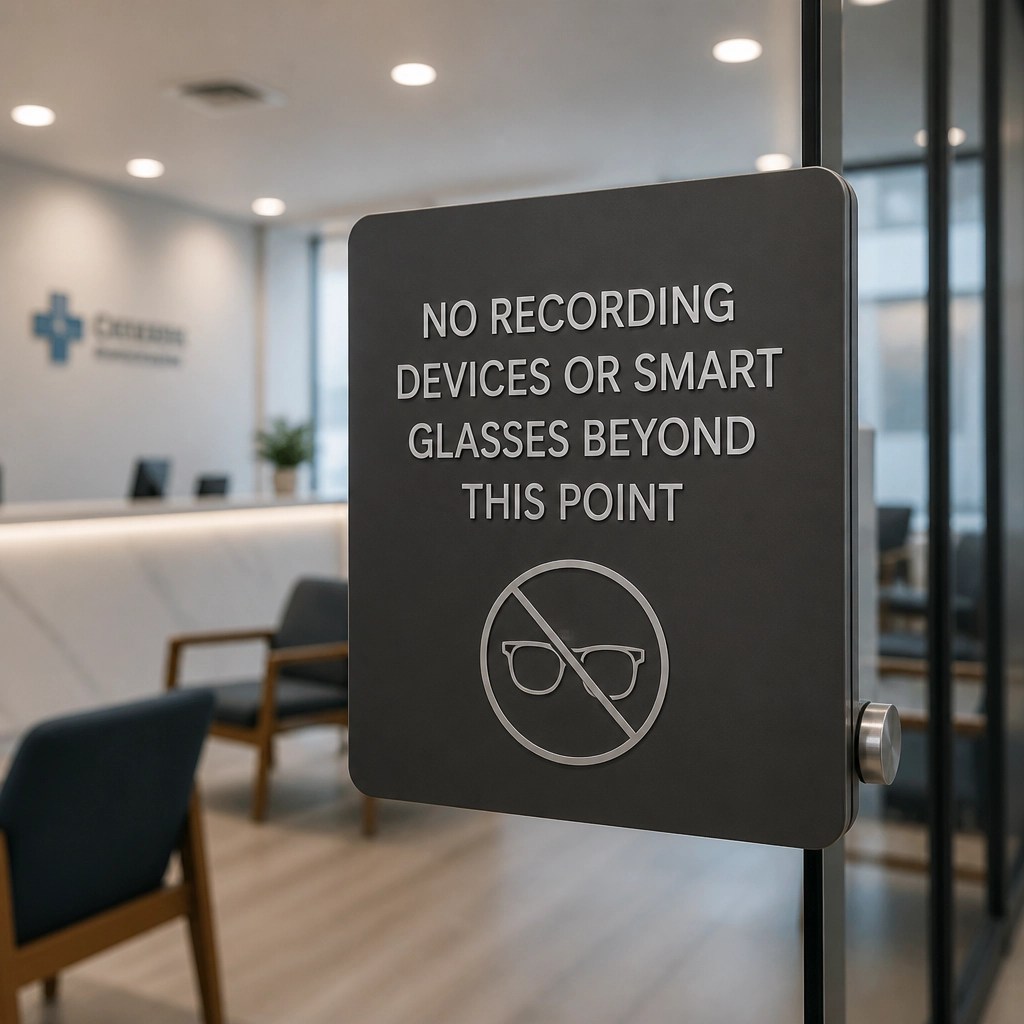
Post Clear Signage
Don't wait for someone to walk in with them. Post clear, professional signs at your entrances in Lexington and Georgetown. A simple "No Smart Glasses Beyond This Point" sign sets the expectation immediately.
Staff Training is Key
Your team needs to know what to look for. These glasses look like regular frames, but they have small LED lights that blink when recording. Train your staff to politely ask patients to remove them or put them away if they are entering an exam room.
Implement a Managed Security Strategy
The best defense is a proactive one. At IT-Necessity, we help practices implement "Defense-in-Depth." This means hardening your internal network so that even if a device tries to "phone home," your security layers are looking for unauthorized data exfiltration.

Why Local Support Matters (Not a "Ticket Mill")
When you call a big, national IT firm, you're just a number in a queue. They might not understand the specific layout of your Frankfort clinic or the importance of your Lexington patient base.
At IT-Necessity, we’re "boots-on-the-ground." We are a veteran-owned MSP based right here in Georgetown. When we talk about security, we aren't reading from a script: we’re looking at your specific environment, from your structured cabling to your security cameras. We answer the phone, we show up in person, and we speak plain English.
FAQ: Smart Glasses and HIPAA
Q: Can patients wear Meta glasses in the waiting room?
A: While the waiting room is less sensitive than an exam room, it's still a high-risk area. PHI is often discussed at the front desk. We recommend a blanket policy that prohibits smart glasses in any area where patient information is handled.
Q: Are there any "HIPAA-compliant" smart glasses?
A: There are specialized enterprise AR (Augmented Reality) glasses designed for surgery or remote assistance that can be compliant if the vendor signs a BAA and the data remains encrypted and controlled. Meta Ray-Bans are consumer devices and do not fit this category.
Q: What if a staff member wants to use them for "hands-free" notes?
A: Unless you have a specific, vetted enterprise platform with a BAA in place, the answer is a hard "No." Using a consumer app to record notes is a massive security hole.
Q: How do we tell a patient to take them off?
A: Focus on "Patient Privacy." Most people are reasonable if you explain that the office has strict rules to protect their data and the data of other patients.
Final Thoughts: Security is a Necessity
Technology moves fast, but the rules of patient trust don't change. Whether it's the latest AI glasses or a legacy server in your back room, your job is to keep that data safe. Our job is to make that easy for you.
Don't let "cool tech" turn into a $50k headache. If you're unsure if your Central Kentucky medical office is truly HIPAA-compliant, let's talk. No hidden fees, no high-pressure sales: just a real conversation about keeping your practice secure.
Ready to lock down your practice’s security?
Schedule a Free Assessment with IT-Necessity today.
About the Author: IT-Necessity
IT-Necessity is a veteran-owned Managed Service Provider (MSP) based in Georgetown, Kentucky. We provide proactive IT support, cybersecurity, and low-voltage technology solutions for medical offices and businesses throughout Lexington, Frankfort, and Central Kentucky. We believe in "Security-First" IT and plain-English support that actually gets the job done.
Categories: Cybersecurity, Healthcare IT, HIPAA Compliance
Tags: Meta Glasses HIPAA, Lexington Healthcare IT, Medical Privacy Kentucky, Georgetown IT Support, HIPAA Compliance Risks, Smart Glasses in Hospitals
Leave a Reply